The French War Memorial: A Sobering Tribute on Pondicherry’s Promenade
When you walk along the bustling Seaside Promenade at sunset, the energy is usually electric. You have children running with cotton candy, couples sitting on the black volcanic rocks, and the distant sound of ships blowing their horns in the Bay of Bengal. But right in the middle of Goubert Avenue, directly opposite the towering Mahatma Gandhi Statue, the energy abruptly shifts.
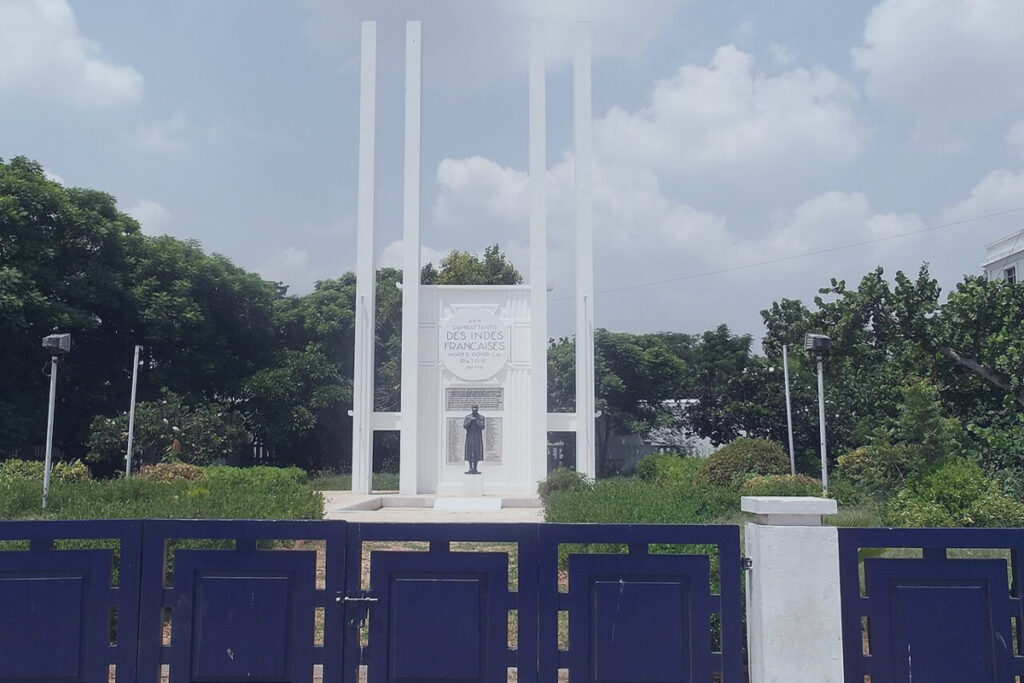
Set back slightly from the chaotic street, surrounded by impeccably manicured green lawns and tall, swaying casuarina trees, is a stark white structure. This is the French War Memorial Pondicherry (officially known as the Monument aux combattants des Indes françaises morts pour la patrie).
It is one of the most meaningful, peaceful, and visually striking historical landmarks in the entire Union Territory. It stands as a silent, solemn tribute to the soldiers who left the tropical heat of South India to fight and die in the freezing, muddy trenches of Europe during World War I and subsequent global conflicts.
Whenever history buffs ask me where to find the absolute intersection of French and Indian heritage, I bring them here. It is a place that forces every visitor to pause, reflect, and honor a deeply complex shared past.
A Tribute to Sacrifice and Shared History
To truly understand the significance of the French War Memorial in Pondicherry, you must look beyond its beautiful architecture and consider who it was actually built for.
When World War I broke out in 1914, the French Republic called upon its global empire for troops. Thousands of young men from the French Indian territories—including Pondicherry, Karaikal, Mahe, and Yanam—answered that call. Many of these men were local Tamils who had never seen snow, let alone experienced the horrors of modern artillery warfare. They boarded ships in the Bay of Bengal and sailed across the world to fight alongside the French Poilus (infantrymen) on the Western Front.
Hundreds of them never came back.
The Foundation and Architecture of the French War Memorial Pondicherry was commissioned in 1937 to ensure their sacrifice was never forgotten. Governor Crocicchia officially inaugurated it on April 3, 1938.
Designed by the brilliant architect Delafon, with poignant sculptures created by Gaston Petit, the striking white granite structure is a masterclass in elegant simplicity. It features four tall, sturdy columns supporting a graceful central dome. Beneath the dome rests a life-size statue of a soldier, head bowed, leaning heavily on his rifle in a classic pose of mourning and exhaustion.
When you stand at the iron gates of the French War Memorial Pondicherry, you can see the massive bronze plaque mounted on the back wall. It lists the names of the fallen heroes. Over the decades, additional plaques were added to honor the soldiers lost in World War II, the brutal French War in Indochina, and the Algerian War. It is a physical timeline of global conflict, written in bronze and stone right on the Indian coastline.
The Spectacle of Bastille Day
For most of the year, the French War Memorial Pondicherry remains a quiet, gated sanctuary. Visitors can view the monument from the street and take photographs of its brilliant white facade set against the green grass.
But if you happen to be in the city during the middle of summer, the entire memorial undergoes a staggering transformation.
Bastille Day (July 14th)
Every year, on the French National Day (Bastille Day), the gates are opened to the public. The entire French War Memorial Pondicherry is spectacularly illuminated with thousands of lights, bathing the white granite and the surrounding trees in the colors of the French tricolor flag—blue, white, and red.
A deeply solemn ceremony is conducted early in the morning. Local government representatives, staff from the nearby French Consulate, military personnel, and war veterans (or their descendants) gather in full uniform. The haunting sound of bugles plays La Marseillaise (the French national anthem), followed by the Indian national anthem, Jana Gana Mana. Dignitaries laid massive wreaths of fresh flowers at the base of the soldier statue to pay tribute to the fallen.
It is, without a doubt, one of the most poignant and visually stunning cultural events in Puducherry, perfectly symbolizing the enduring, unbreakable bond between France and India.
Armistice Day (November 11th)
Similarly, smaller but equally moving ceremonies are held at the French War Memorial Pondicherry every year on Armistice Day, commemorating the exact moment World War I officially ended.
Plan Your Visit
Because it is located dead center on the most popular tourist strip in the city, the French War Memorial Pondicherry is incredibly easy to visit.
- Location: Goubert Avenue, right on the edge of the White Town Walking Guide boundary. It is situated directly opposite the Gandhi Statue and just a few blocks away from the Old Lighthouse.
- Timings: You can view the memorial from the street at any time. The gates are generally closed to preserve the manicured grounds, but the memorial is fully visible.
- Entry Fee: Completely free of charge, making it an essential addition to your list of Best Free Activities.
- The Best Time to Go: If you want incredible photography, go right at sunrise (around 6:00 AM). The Best Sunset Points in Pondicherry might be elsewhere, but the golden morning light hitting the white columns of the memorial, with the blue ocean behind you, is absolutely breathtaking.
Why You Must Stop Here
The French War Memorial Pondicherry is highly accessible, visually stunning, and historically vital.
You should visit to gain genuine historical insight into the city’s unique colonial past. You should visit to pause and honor the massive sacrifices made by the local Indian soldiers who fought in wars half a world away. And, practically speaking, you should visit because its striking white columns set against the lush green backdrop of the park offer some of the best, most dramatic photo opportunities in the entire French Quarter.
So, the next time you are eating an ice cream cone and strolling down the Promenade, take two minutes. Stop at the iron gates of the French War Memorial Pondicherry. Read the names on the bronze plaques. And just listen to the silence beneath the dome.
Recent Post

Tags