Immaculate Conception Cathedral: A 300-Year-Old Legacy in Puducherry
If you take a stroll down Mission Street on any given afternoon, your senses are going to be overwhelmed. It is one of the busiest, most chaotic commercial arteries in the city. You have auto-rickshaws honking, street vendors haggling, and the thick, humid heat of the South Indian coast pressing down on you.
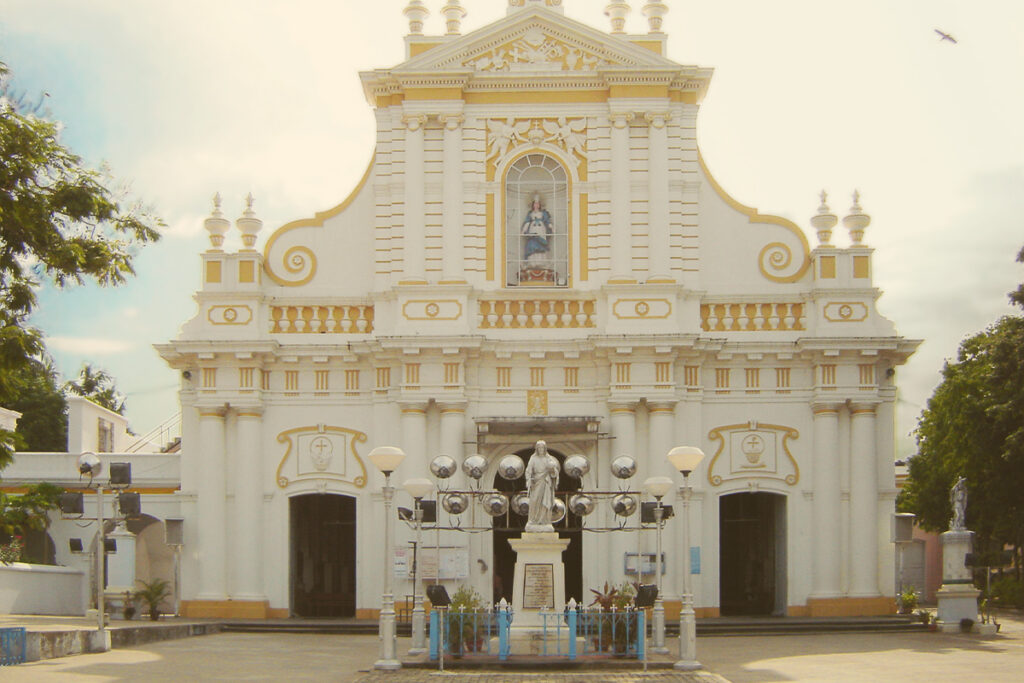
But right in the middle of all that beautiful, noisy chaos, the street suddenly opens up. Standing behind an iron gate, framed by palm trees, is a massive, blindingly white structure trimmed in gold and pastel yellow.
This is the Immaculate Conception Cathedral.
When travelers ask me where to find the absolute soul of the city’s colonial history, I don’t just point them to the beaches. I point them here. Known officially as Eglise de Notre Dame de la Conception Immaculée, this isn’t just a place of worship. It is a staggering monument to human resilience. The Immaculate Conception Cathedral has survived centuries of brutal colonial warfare, total demolition, and the test of time to become one of the oldest and most beautiful churches in South India.
Let me tell you the story of how this magnificent building survived the crossfire of empires.
An Epic Saga of Destruction and Resilience
To truly appreciate the Immaculate Conception Cathedral, you have to understand that the building you are looking at is actually version 4.0.
The story starts way back in 1699. The French Jesuit Fathers arrived in Pondicherry and bought a large plot of land to build a church. They even received direct financial backing from King Louis XIV of France. But Pondicherry in the 17th and 18th centuries was a massive geopolitical warzone. The European powers were constantly fighting over this tiny stretch of the Coromandel Coast.
Within a few years of its construction, the Dutch invaded the city and absolutely leveled the church to the ground.
When the French eventually got the city back, the locals and the priests stubbornly rebuilt it. But their peace didn’t last long. In 1761, during the bitter Seven Years’ War, the British military laid siege to Pondicherry. Following their victory, the British ordered the systematic destruction of all major French landmarks. The church was, once again, annihilated.
It wasn’t until 1791, over two hundred and thirty years ago, that the current structure of the Immaculate Conception Cathedral was finally consecrated on the ruins of its predecessors. When you touch the thick masonry walls here, you are touching a monument built by people who simply refused to give up.
The Architecture: A European Masterpiece in the Tropics
Unlike the towering Gothic spires of the Basilica of the Sacred Heart of Jesus, located further down the boulevard, the Immaculate Conception Cathedral features a very different architectural soul.
It is built in a stunning Herrerian or Colonial Baroque style. If you have ever visited the ancient Portuguese churches of Old Goa, the facade here will look incredibly familiar.
The Exterior Grandeur
When you stand in the front courtyard, the grand facade commands your attention. It features graceful, sweeping scroll-shaped curves, twin bell towers, and sturdy Doric columns. The exterior is painted in a brilliant, soft cream and white, which practically glows against the deep blue Pondicherry sky.
The Serene Blue Nave
The real magic happens when you step through the heavy wooden doors. The sheer drop in temperature is immediate. The thick walls keep the tropical heat out, and the noise of Mission Street simply vanishes.
The interior of the Immaculate Conception Cathedral is breathtaking. The sprawling central nave features a massive, high-arched barrel ceiling. Instead of leaving it bare, the ceiling is painted in a soft, heavenly blue, creating a feeling of infinite space and calm. Golden pillars line the central aisle, leading your eyes straight to the ornately carved, brightly illuminated main altar. It is, without a doubt, a photographer’s absolute dream.
The Mystery of the Name “Samba Kovil”
Here is a piece of local trivia that most generic travel guides miss completely. If you jump into an auto-rickshaw and ask the driver to take you to the Immaculate Conception Cathedral, they might look at you with a blank stare.
You have to tell them to go to “Samba Kovil.”
But where did that name come from? It is a brilliant example of how European and Tamil cultures merged here. Originally, the site was associated with Saint Paul. In the local Tamil dialect, “Saint Paul” was phonetically adapted and corrupted over generations into “San Paul,” and eventually “Samba.” The Tamil word for temple or sacred space is “Kovil.”
Thus, Saint Paul’s Church became Samba Kovil. It is a perfect linguistic timestamp of the city’s unique Franco-Tamil heritage.
The Mother Church and Mother Teresa
Today, the Immaculate Conception Cathedral serves as the “Mother Church” for the Roman Catholic Archdiocese of Pondicherry and Cuddalore. It is the official residence of the Bishop and the spiritual epicenter for the local Catholic community.
The energy here is always vibrating with devotion. Throughout its modern history, the cathedral has hosted incredible figures, including Saint Mother Teresa, who prayed in these exact pews during her visit to Puducherry.
If you happen to be visiting in the winter, particularly on December 8th, you are in for an incredible experience. The Feast of the Immaculate Conception is celebrated with massive fanfare. The entire facade is draped in brilliant lights, the courtyard is flooded with flowers, and thousands of devotees from all religious backgrounds gather to celebrate.
How to Plan Your Visit
Because it is located right in the commercial heart of town, fitting the Immaculate Conception Cathedral into your itinerary is incredibly easy.
- Location: Mission Street (Cathedral Street), right on the edge of the White Town Walking Guide boundary.
- Timings: The church is open daily from 7:00 AM to 12:00 PM, and again from 3:00 PM to 8:30 PM.
- The Best Time to Go: I highly recommend going right at 7:00 AM. The morning mass is incredibly peaceful, the light filtering through the windows is golden, and you have the space mostly to yourself before the tourist buses arrive.
- Dress Code: Like all active places of worship in India, modest dress is required. Please avoid wearing shorts or sleeveless tops when entering the sanctuary.
Once you finish taking in the history and the silence, you can step right back out into the vibrant chaos of Mission Street. From there, you are just a five-minute walk from the famous Manakula Vinayagar Temple, or you can hunt down the Best Street Food for a quick afternoon snack before heading toward the Seaside Promenade.
Whether you are drawn here by deep faith, a love for colonial architecture, or a desire to understand history, this cathedral is a mandatory stop. It is a divine, enduring verse in Pondicherry’s long poem of cultures.
Recent Post
Tags