Sri Karneshwar Nataraja Temple: Puducherry’s Unique Pyramid-Shaped Temple
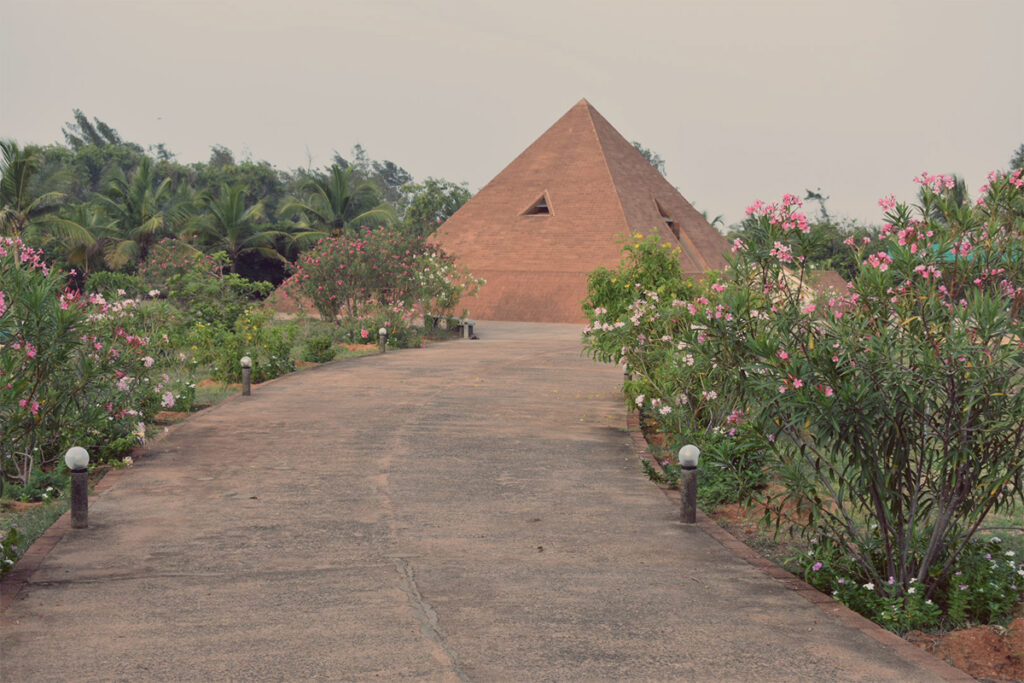
If you have spent any time traveling through South India, your eyes quickly adjust to the skyline. You expect to see massive, brightly painted gopurams (temple towers) intricately carved with thousands of deities piercing the sky. But if you take a drive down the scenic East Coast Road just north of Pondicherry, you will stumble upon a silhouette that completely breaks the mold.
Sitting quietly on the golden sands of Pudukuppam Beach is a structure that looks like it was teleported straight from Giza. This is the Sri Karneshwar Nataraja Temple, and it is arguably the most unique, unusual, and mathematically precise Shiva temple in the entire world.
Dedicated to Lord Shiva in his cosmic dance form of Nataraja, this temple isn’t just an architectural novelty. It is a powerful sanctuary for meditation that perfectly bridges ancient Hindu traditions, Egyptian sacred geometry, and modern eco-friendly engineering. When travelers ask me for a quiet, off-the-beaten-path spiritual experience away from the bustling crowds of White Town, the Sri Karneshwar Nataraja Temple is always at the top of my list.
Let me tell you the story of how a pyramid ended up on a South Indian beach, and why you need to experience the energy inside it for yourself.
A Story of Devotion, Destruction, and Resilience
The history of the Sri Karneshwar Nataraja Temple is not ancient, but it carries the emotional weight of a millennia-old saga. It is a modern testament to sheer human resilience.
The story begins in the year 2000. Dr. Karan Singh, the Chairman of the Auroville Foundation and a descendant of the royal family of Kashmir, had a lifelong vision. As a deeply devoted follower of Lord Shiva, he wanted to build a sanctuary that merged the sacred pyramid shape of the Egyptians with the Hindu deity Nataraja—something that had never been done in history. He built the original temple right here on the beach.
For four years, it stood as a quiet place of prayer. Then came December 26, 2004.
The devastating Indian Ocean Tsunami swallowed the coastline. The massive waves completely leveled the original, smaller temple, leaving almost nothing behind but sand and grief. But faith in Pondicherry runs deep. Instead of abandoning the site, Dr. Singh decided to rebuild.
He approached the brilliant architects at the Auroville Earth Institute to construct a new Sri Karneshwar Nataraja Temple on the same spot. This time, it would be bigger, stronger, and built to withstand the wrath of the ocean.
The Architecture: Where Sacred Geometry Meets Earth
When the Auroville Earth Institute took over the project in 2006, they didn’t just pour standard concrete. The new Sri Karneshwar Nataraja Temple is a masterclass in sustainable engineering and spiritual physics.
The Egyptian Connection
The most striking feature of the temple is, of course, its shape. The architects used the exact geometric proportions of the Great Pyramid of Egypt to design the pointed cloister dome. In many spiritual traditions, the pyramid shape is believed to act as a funnel, capturing and amplifying positive cosmic energy.
Earth Blocks and Tsunami-Proofing
To ensure the Sri Karneshwar Nataraja Temple would never wash away again, the builders dug the reinforced concrete foundations 1.15 meters below the ground level. The main body of the pyramid was constructed using Compressed Stabilized Earth Blocks (CSEB)—an eco-friendly, highly durable material perfected in nearby Auroville.
Engineering for Energy
Here is a fascinating architectural secret: standard reinforced concrete buildings act like a “Faraday cage,” which can block or disturb natural electromagnetic energies. To prevent this, the builders carefully welded every single iron reinforcement bar together to keep the spiritual energy at its absolute maximum.
Inside the Pyramid: The Alignment of the Gods
The physical construction of the Sri Karneshwar Nataraja Temple is impressive, but the spiritual alignment is what makes the hairs on your arms stand up when you walk inside. Every single inch of this space was calculated with divine intent.
- The Magnetic North: The entire pyramid is oriented precisely toward the magnetic North Pole. This is a common practice in sacred spaces to align the building with the earth’s natural magnetic fields, which many believe enhances deep meditation.
- The Southern Entrance: You enter the temple facing South. In Hindu tradition, this honors Lord Shiva’s form as Dakshinamurti—the ultimate teacher and guru who always faces south to enlighten his disciples.
- The Third Eye Point: This is perhaps the most incredible detail. The beautiful bronze statue of Lord Nataraja is placed on a pedestal calibrated to an exact height. Why? So that the deity’s “third eye” sits exactly one-third of the way up from the base of the pyramid. In sacred geometry, this specific vertical point is considered the absolute core of the pyramid’s power and energy.
The Experience: A Dhyana Mandapam (Meditation Hall)
When you visit the famous Sri Manakula Vinayagar Temple in town, the energy is loud, vibrant, chaotic, and heavily ritualistic. The Sri Karneshwar Nataraja Temple is the exact opposite.
Dr. Singh explicitly built this space to be a Dhyana Mandapam—a house of meditation. You won’t find loud chanting, long queues, or heavy rituals here. When you step through the southern entrance, the first thing you notice is the dim, cooling shade. The second thing you notice is the profound silence, broken only by the rhythmic crashing of the waves on Pudukuppam Beach just a few dozen meters away.
Following traditional Indian customs, there are three paths for pradakshina (circumambulation). You can walk around the idol itself, take the path around the inner walls of the pyramid, or stroll the beautiful garden path around the entire exterior complex.
Aside from Lord Nataraja, the temple also houses serene statues of Lord Ganesha, Lord Murugan, and a small Nandi bull guarding the space.
Practical Tips for Your Visit
Because the Sri Karneshwar Nataraja Temple is located about 15 kilometers north of Pondicherry’s main city center, it makes for a fantastic half-day trip.
- Location: Gangaiamman Koil Street, Pudukuppam Beach (just off the ECR).
- Timings: The temple is open daily from 7:00 AM to 12:00 PM, and again from 4:15 PM to 7:15 PM.
- Entry Fee: It is completely free, making it a wonderful addition to your list of the Best Free Activities around Pondicherry.
- When to Go: The best time to visit is in the late afternoon. You can sit inside the pyramid for half an hour of meditation, and then step right outside onto Pudukuppam Beach to catch the cool evening sea breeze and watch the twilight.
If you are looking for a place where the deep roots of Hindu devotion meet the mysteries of global sacred geometry, you have to add the Sri Karneshwar Nataraja Temple to your itinerary. Take a seat on the cool floor, close your eyes, listen to the ocean, and just let the energy of the pyramid do the rest.