Sri Manakula Vinayagar Temple: Puducherry’s Sacred Ganesha Temple
If you spend even a single day walking through the grid-like streets of the White Town Walking Guide, you will inevitably find yourself drawn toward a specific, rhythmic energy. You will hear the sharp ringing of brass bells, smell the heavy scent of burning camphor and fresh jasmine, and see a massive, brightly painted gopuram (temple tower) rising above the colonial French rooftops.
This is the Sri Manakula Vinayagar Temple.
Long before the French arrived to build their elegant villas, and centuries before tourists started flocking to the Seaside Promenade, this specific spot of land was sacred. The temple is well over 500 years old, predating almost every other structure in the heritage district. It stands today not just as a place of vibrant daily worship, but as an incredible symbol of native resilience against colonial erasure.
When visitors ask me to recommend the most culturally significant spot in the city, the Sri Manakula Vinayagar Temple is always my immediate answer. Let’s explore the miraculous history of Pondicherry’s favorite deity.
The Legend of “The Friend of the White Man”
The name of the temple tells you exactly what this area used to look like centuries ago. In Tamil, Manal means sand, and Kulam means pond. Originally, the deity sat near a sandy freshwater pond right on the edge of the Bay of Bengal.
The temple is devoted to Lord Ganesha, the elephant-headed remover of obstacles, locally worshipped here as Bhavaneshwar Ganapathy. But the history of this specific idol is the stuff of absolute legend.
During the 17th and 18th centuries, the French colonial administration was heavily focused on expanding its territory and enforcing its own religious structures (like the nearby Immaculate Conception Cathedral). The existence of a massive Hindu temple right in the middle of their new, ordered European settlement was viewed as an obstacle.
According to deeply held local history, the French colonizers attempted to destroy the Sri Manakula Vinayagar Temple multiple times. They repeatedly removed the heavy stone Ganesha idol and threw it deep into the ocean. But every single time they did, the idol miraculously reappeared on its pedestal the very next day.
Eventually, the French authorities were so spooked (and ultimately impressed) by the deity’s resilience that they abandoned their demolition plans and allowed the temple to remain. Because the idol survived the colonial purge, locals began affectionately referring to this specific Ganesha as Vellakkaran Pillai, which loosely translates to “The Friend of the White Man.”
Dravidian Grandeur Wrapped in Gold
While the temple’s history is defined by its survival, its modern architecture is defined by sheer, unapologetic grandeur.
Covering nearly 8,000 square feet, the Sri Manakula Vinayagar Temple is a visual explosion of traditional Dravidian art. The moment you step through the majestic Raja Gopuram (the main entrance tower), you are surrounded by intricate stucco sculptures of various deities.
The Golden Spire and Flag Post
But the real breathtaking moments happen inside. The temple is famous for its gold. Standing tall in the outer courtyard is the kodi kambam (flag post), which is completely laminated in gold and stands 18 feet high. If you look up at the Vimanam (the spire directly above the main inner sanctum where the deity sits), you will see that it is also entirely covered in gleaming golden plates.
The Painted Corridors
As you walk the inner Praharams (corridors) to perform your circumambulation, look at the walls. They are covered in dozens of vivid, massive paintings depicting the different incarnations of Lord Ganesha and various scenes from Hindu mythology. It feels like walking through an ancient, illuminated manuscript.
Remembering Lakshmi: The Temple Elephant
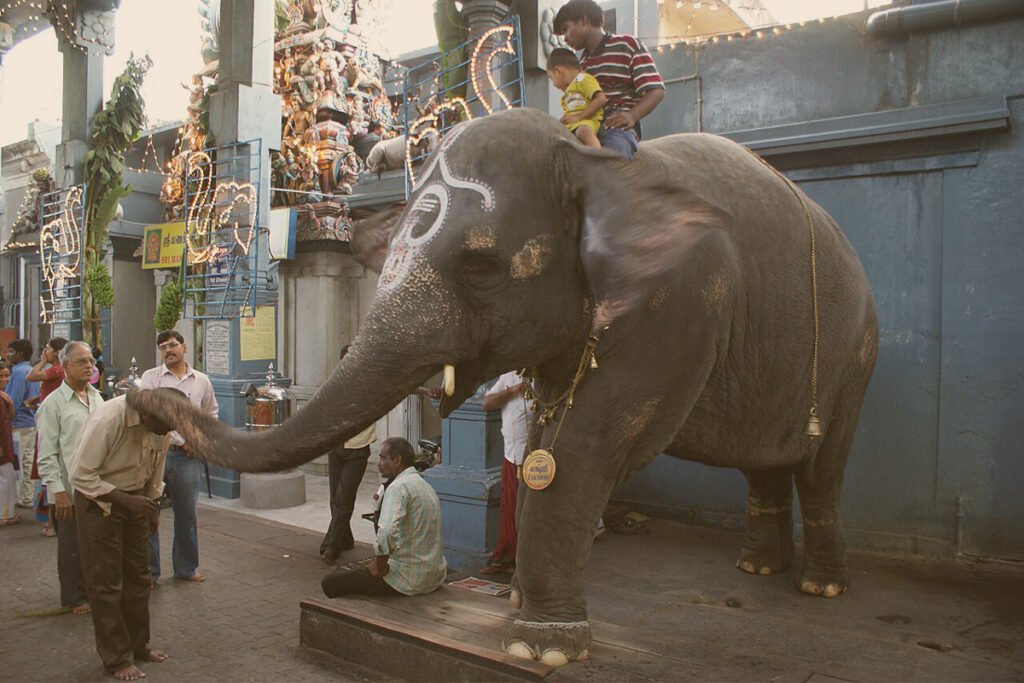
For decades, a visit to the Sri Manakula Vinayagar Temple wasn’t complete without meeting Lakshmi.
Lakshmi was the beloved resident temple elephant. She would stand near the entrance, and devotees would offer her a coin or a piece of fruit. In exchange, she would gently tap her warm, heavy trunk on the top of your head in a gesture of blessing.
Tragically, Lakshmi passed away a few years ago. The entire city of Pondicherry—cutting across all religions and backgrounds—went into deep mourning. The streets were flooded with thousands of people who came to pay their final respects to the gentle giant. While she is no longer physically at the temple, her memory is permanently etched into the soul of the Sri Manakula Vinayagar Temple, and you will still see locals tear up when talking about her.
The Golden Chariot and Major Festivals
If you happen to visit during a major Hindu festival, the energy at the Sri Manakula Vinayagar Temple is unbelievable.
The Golden Chariot
The temple houses a magnificent chariot made of solid teak wood. What makes it spectacular is that it is entirely covered in 7.5 kilograms of pure gold, funded completely by the donations of devotees. On auspicious days, the deity is placed inside this golden chariot, and devotees pay a fee to physically pull the chariot around the inner corridors.
Brahmotsavam and Ganesh Chaturthi
The temple’s main annual festival, Brahmotsavam, runs for 24 days in August and September. But the absolute peak of celebration happens during Ganesh Chaturthi. The entire street is closed off, massive light displays are erected, and the temple stays open late into the night.
The most spectacular single event, however, is the Golden Chariot Procession held annually on Vijayadashami day (during the Navaratri festival). The heavy golden chariot is pulled out of the temple and paraded through the four main Mada streets surrounding the complex, accompanied by massive crowds, traditional drumming, and chanting.
Practical Tips for Your Visit
Located right on Manakula Vinayagar Koil Street in White Town, you can easily walk here from the Seaside Promenade or Bharathi Park.
- Darshan Timings: The Sri Manakula Vinayagar Temple is open daily from 5:45 AM to 12:30 PM, and again from 4:00 PM to 9:30 PM.
- When to Go: If you want a quiet, meditative experience, go right when the doors open at 5:45 AM. If you want to experience the chaotic, vibrant energy of a living South Indian temple, go around 6:00 PM for the evening Aarti (fire ritual).
- Entry Rules: Entry is free, though you can buy special darshan tickets for faster access. Modest dress is strictly required—shoulders and knees must be covered. You will also need to leave your footwear and any leather items (like belts or bags) at the designated stalls outside before entering.
Whether you are seeking spiritual blessings, marveling at the Dravidian architecture, or just trying to understand the deep, pre-colonial history of Puducherry, the Sri Manakula Vinayagar Temple is a mandatory stop. Buy a garland of jasmine flowers at the gate, step inside, and feel the ancient heartbeat of the city.
Recent Post
Tags