Villianur Temple: A Guide to Sri Gokilambal Thirukameswarar Temple
When most people think of Puducherry, their minds immediately jump to the mustard-yellow villas of the White Town Walking Guide or the peaceful meditation halls of the Sri Aurobindo Ashram. But if you drive just 10 kilometers inland, away from the coastal sea breeze, you will hit a town that holds a piece of history far older than any French settlement.
Welcome to the Villianur Temple (officially known as the Sri Gokilambal Thirukameswarar Temple).
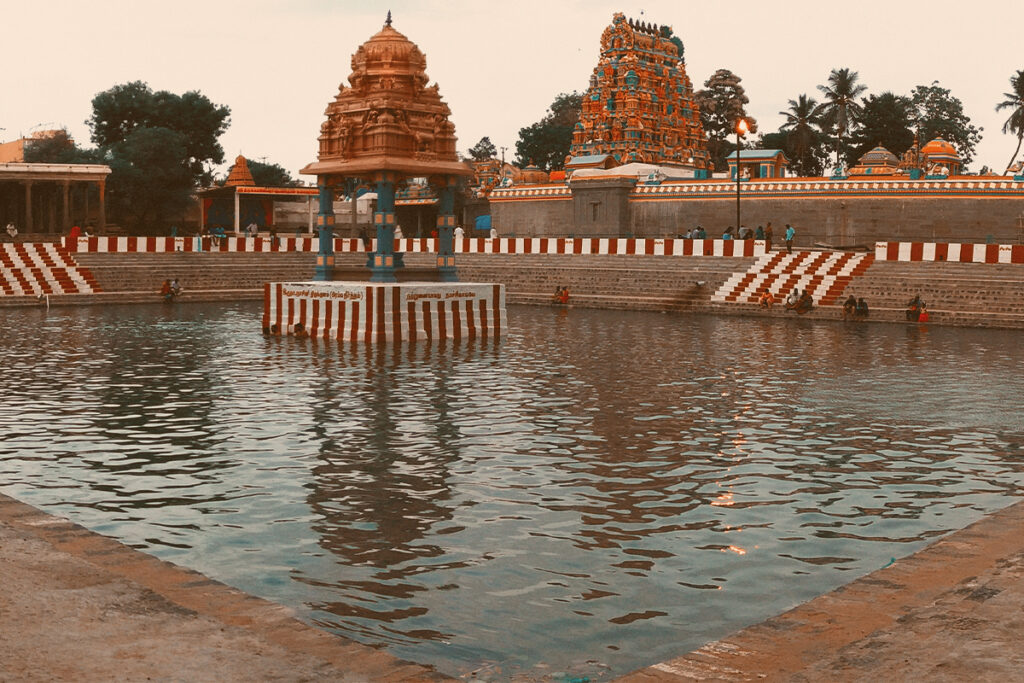
Sprawling across a massive 4.3-acre complex, this is not just another neighborhood shrine. It is a 1,000-year-old architectural masterpiece of the Chola dynasty. It is a site of legendary medical miracles. And, strangely enough, it is one of the only ancient Hindu temples in India where French colonial governors actively participated in the religious festivals.
If you want to step away from the cafes and beaches for a day to feel the heavy, ancient pulse of South Indian spirituality, the Villianur Temple is an absolute must-visit. Let’s dive into the incredible stories hidden inside these stone walls.
The Legend of the Leper King
To understand the sheer importance of the Villianur Temple, you have to go back to the 12th century, specifically to the reign of the mighty Chola Empire.
According to local lore, a prominent Chola King was suffering from a severe skin disease, often described in historical texts as leprosy or severe leucoderma. Desperate for a cure and exhausted by failed medical treatments, the king embarked on a spiritual pilgrimage. His journey brought him to a dense forest of Vilwa trees (sacred to Lord Shiva).
Within this forest, he discovered a self-manifested Shiva Linga and a sacred pond, known as the Brahma Theertham. The king bathed in the waters and fervently worshipped the deity. Miraculously, his skin disease was completely cured. Overwhelmed with gratitude, the King ordered a magnificent temple to be built around the deity. He cleared the forest and established a town, originally called Vilwanallur (The Good Town of Vilwa Trees), which over the centuries morphed into the name we use today: Villianur.
Dravidian Grandeur and a French Watchtower
When you approach the Villianur Temple, the first thing that forces you to look up is the sheer scale of the architecture. The temple complex is enclosed by massive, concentric rectangular granite walls, built to protect the sacred inner shrines.
The Towering Gopurams
The main eastern entrance is guarded by a stunning 5-tiered Rajagopuram (gateway tower), dripping with intricate stone carvings of Hindu mythology. But it is the 7-tiered South Gopuram that holds a bizarre piece of colonial history. During the 18th century, when the French and British were constantly warring over the territory, the French military actually used this towering South Gopuram of the Villianur Temple as a strategic monitoring and sniper tower to watch for approaching enemy troops!
The Mud Lingam
Inside the dark, cool, and heavily perfumed inner sanctum sits Lord Thirukameswarar. Unlike most Shiva Lingas, which are carved from solid black granite, the deity here is made of mud. Because you cannot pour water over unbaked mud without washing it away, the priests cover the Lingam with a gleaming brass armor before performing the daily Abhishekas (sacred bathing rituals).
The Solar Miracle
Here is a secret that proves the architectural genius of the Chola builders: if you visit the Villianur Temple during the Tamil month of Panguni (specifically around the 9th, 11th, and 19th days), the temple is perfectly aligned so that the rays of the rising sun pass through the corridors and fall directly onto the Shiva Linga.
The Mystery of the Prasava Nandi
As you walk through the complex, you will see the standard large statue of Nandi (the sacred bull) facing Lord Shiva. But look closely between the large Nandi and the main sanctum.
There is a smaller, highly unusual Nandi resting on a rotating wooden plank. This is the Prasava Nandi. For centuries, pregnant women have come to the Villianur Temple to pray specifically to this small bull, seeking blessings for a safe and healthy delivery. It is a deeply intimate, quiet tradition that locals hold very dear.
Brahmotsavam: The Great Temple Car Festival
While the temple is peaceful on most days, it absolutely explodes with energy during the Tamil months of May and June for the annual Brahmotsavam festival.
The undisputed highlight of this 10-day celebration is the Temple Car Festival. The priests bring out a staggering 15-meter (50-foot) tall wooden chariot, intricately carved and heavily decorated with bright silks and flowers. The idols of Lord Thirukameswarar and Goddess Gokilambal are placed inside, and thousands of devotees gather to physically pull the massive chariot through the streets of the town using thick coir ropes.
The French Connection Continues
What makes the festival at the Villianur Temple so unique is its history of inclusivity. During the French colonial era, it became a rigid tradition for the French Head of State (the Governor) to personally inaugurate the festival and help pull the chariot. The French respected the temple so much that they even funded its maintenance for years.
Today, that spirit of unity remains. The festival famously blurs the lines of caste and religion, with people from all communities—including local Christians and Muslims—stepping up to pull the ropes, believing that moving the chariot brings universal prosperity to the town.
Plan Your Visit
If you are putting together an itinerary of the Must-Visit Places in Pondicherry, you cannot leave this off the list.
- Location: East Car Street, Villianur (about a 20-minute drive from the city center).
- Darshan Timings: The Villianur Temple is open daily from 6:00 AM to 12:00 PM and from 4:00 PM to 9:00 PM.
- Entry Fee: Free.
- Pro-Tip: If you are visiting during the summer, the granite floors get blistering hot by 10:00 AM. Try to arrive right at 6:30 AM. The air is cool, the morning chants are echoing through the stone pillars, and you can grab a hot filter coffee from a local stall right outside the gates afterward.
Whether you are an architecture buff, a history nerd looking for colonial footprints, or a spiritual seeker, the Villianur Temple offers an experience that the beaches simply cannot match. Take an auto-rickshaw out of the city, buy some jasmine flowers at the gate, and step back a thousand years in time.
Recent Post

Tags